
Turner and Constable: were they really so different?
A Tate Britain exhibition — part 2

In my Turner & Constable fire and water article two weeks ago – which you can read here – I wrote about the Tate Britain’s exhibition, on until the 12th April 2026, capturing perfectly the rivalry and relationship between the two painters.
The critics of the time — like the critics of every time I guess — were delighted by the relationship between the two artists. They loved the gossip and they thrived in finding the best comment and critique for their latest painting.
The Turner and Constable: Rivals and Originals exhibition catalogue contains some of the best comments:
..their work was deemed ‘equally successful’, though Constable was said to have ‘none of the poetry of Nature like Mr Turner, but… more of her portraiture.
Or:
There could be ‘no stronger contrast’ to Turner than Constable.
As one critic wrote in 1829 referring to the contrast between Constable’s Hadleigh Castle: The Mouth of the Thames, Morning After a Stormy Night, and Turner’s Ulysses deriding Polyphemus.
And the critique goes on:
Constable was ‘all truth’ and Turner was ‘all poetry: the one is silver, and the other gold’.
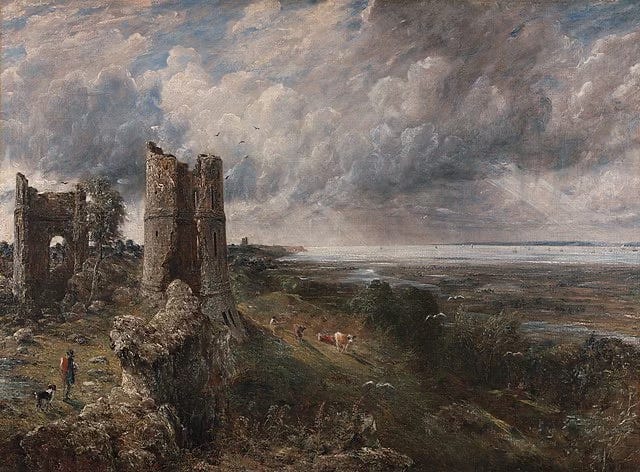
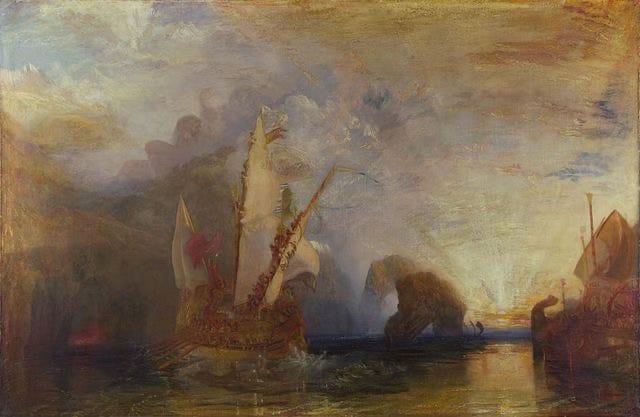
So, Constable and Turner’s work was constantly compared but perhaps it was all part of Constable’s plan.
During the Royal Academy Summer Exhibition of 1831, which gave them the fire/water, heat/humidity relationship, Constable was part of the hanging committee of the exhibition, and while most artists of the time didn’t want to have their work next to Turner for fear of comparison, Constable purposefully placed his Salisbury Cathedral from the Meadows in direct ‘dialogue with Turner’s work.’
This opposition played a massive role in creating the mystique of the rivalry and shaping the relationship between the two artists, who respected and admired each other’s work but also competed until their last breath.
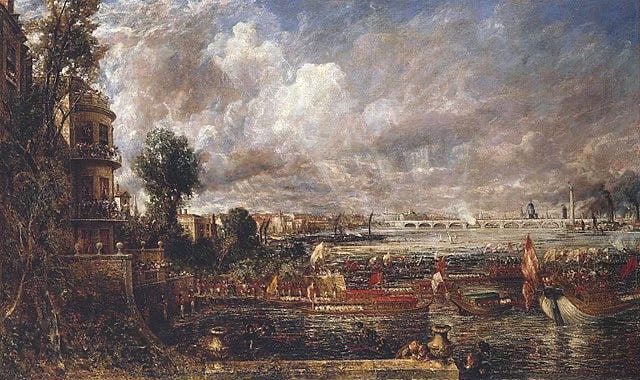
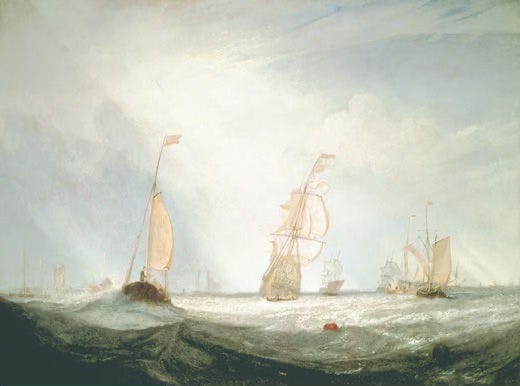
In particular, Constable liked the comparison to continue and the antagonism reached the next level at the 1832 Summer Exhibition, when Turner, after observing and studying Constable’s The Opening of Waterloo Bridge hanged next his Helvoetsluys, made a move nobody anticipated.
Turner took directly from the dispersed red of Constable battle, and added a small dot of red paint to his ‘pastel-coloured seascape’ while it hung on the walls of the Royal Academy. This was a response to Constable 1831’s first act of the battle. It was the continuation of their love affair, silent but clearly under everyone eyes.
When Constable saw the red mark appearing last minute to his rival’s painting, he was astonished. He was left speechless, in disbelief. After pausing briefly he said, ‘he [Turner] has been here…and fired a gun’ and he left the room in a mix of desperation and admiration.
Perhaps the two men were polar opposites not just in their art, but in their everyday life and belief.
Constable was married and had seven children, which he single parented when his wife died in 1828. Turner had two daughters but never fathered them, believing that marriage and fatherhood were real obstacles to true art. They grew up in completely different places and environments. Turner in his father’s barber shop in Covent Garden, the heart of commercial London at the time, while Constable in the quiet and wealthy Suffolk countryside. Turner’s landscape style made him famous quickly, endorsed early on by senior artists at the Royal Academy School and becoming a full Academician at the age of 27, with a long list of commissions he could barely keep up with. Constable took longer, and sold much less for a while, until the age of 53 when he was able to acquire the Academician title.
But the main difference between the two was their style. Their style was so dissimilar that it looked like it belonged to different times, to the point that some people couldn’t believe they were born only a year apart.
The Tate’s exhibition seems to work against this narrative, or better, provocatively put the two together to analyse differences but mostly similarities, and leave the spectator with a question:
Were they really so different?